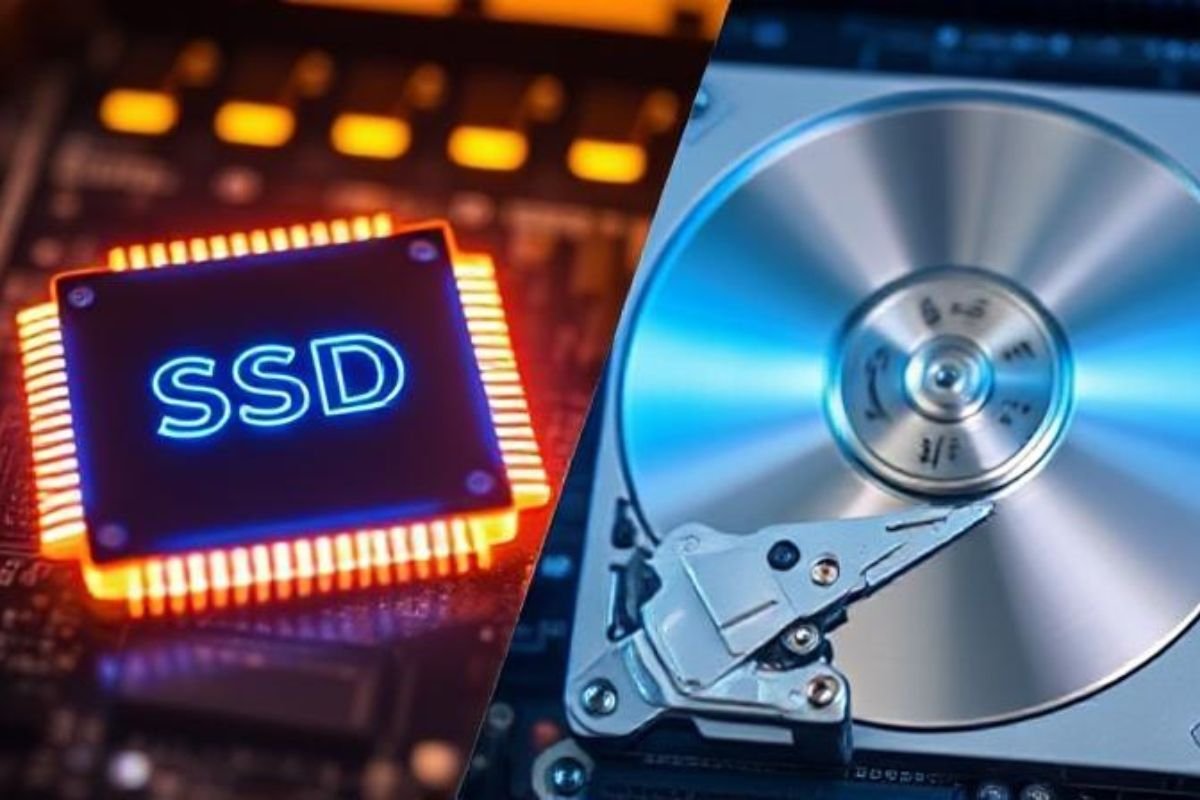
When it comes to computers, storage drives are like the heart of your system. They determine how fast your files load, how quickly your computer starts, and even the smooth your gaming feels. Two main types of storage dominate the market today: HDD (hard disk drive) and SSD (solid-state drive). But which one is right for you? Let’s dive deep into your performance gap and see who saves.
What is an HDD?
A HDD (hard disk drive) is a traditional storage option that has been around for decades. It uses spinning magnetic platters and a mechanical hand to read and write data. Think of it like a record player, but for your computer.
How it works: Data is collected magnetically, and the head of reading/writing on the spinning discs to access it.
General Uses: Bulk storage, backup, and budget PC where greater capacity is more important than speed.
What is an SSD?
A SSD (solid-state drive) is a modern option, which depends on flash memory chips rather than shaking parts. It acts like a huge USB flash drive inside your computer.
How it works: Data is stored in Nanda Flash Memory, with quick access rather than mechanical movement.
General Uses: Operating system, gaming, professional workload, and laptop where speed and durability matter.
Significant difference between SSDs and HDDs
| Feature | HDD | SSD |
|---|---|---|
| Technology | Magnetic platters + mechanical arm | NAND flash memory |
| Speed | Slower read/write | Extremely fast |
| Durability | Prone to damage from drops | Resistant to shock |
| Noise | Audible spinning | Silent |
| Cost | Cheaper per GB | More expensive per GB |
Motion performance: SSD VS HDD
The speed is the place where SSDs shine.
Boot Time: An HDD can take 30-60 seconds to boot Windows, while an SSD can do it within 10 seconds.
Application Loading: Programs such as Photoshop or games open almost immediately on SSDs, while HDDs fall behind.
File Transfer: Copying the 10GB file may take several minutes on an HDD, but a few seconds on an SSD.
Stharma and Reliability
Because HDD has moving parts, they are unsafe to physical damage. A small drop or sudden shake can ruin your data.
On the other hand, SSDs have no moving parts. This makes them ideal for laptops and portable devices, more resistant to shock.
Storage capacity idea
HDDs can go up to 20TB or more, making them ideal for mass storage. Catching SSD, consumers drive 8TB, but they remain expensive.
If you want cheap bulk storage, HDD wins. If you want speed, an SSD is a worthwhile investment.
Electric consumption and heat
HDDs consume more power due to spinning platters. They also produce more heat, which can affect the performance in a long time.
SSDs are more energy-efficient, which makes them perfect for laptops where battery life matters.
Noise level and user experience
Have you ever heard that your PC is clicking an unconscious whisper or sound? This is your HDD at work. On the other hand, SSD, completely silent – no noise, no moving parts.
Gaming performance: SSD VS HDD
Gamers know long loading screen pain. With SSD, those screens shrink to a large extent. Open-world games stream textures and maps very fast, eliminating stores that are often accompanied for HDD storage.
While an HDD can still store your game, an SSD dramatically improves the overall gaming experience.
Professional charge
If you are in video editing, 3D modeling, or data analysis, then SSD is almost a requirement. They handle large-scale file transfer and real-time editing smoothly. HDDs cannot live only with modern professional workloads.
laptop vs desktop uses
Laptop: SSD dominates because they are light, shockproof, and batteries improve life.
Desktop: Some users still combine HDDs for mass storage with SSDs for speed.
Hybrid Storage Solutions
For those who want the best of both worlds:
Sshds (hybrid drive): Mix a small SSD cache with a large HDD for speed and storage balance.
Dual-Drive System: Many gamers and professionals install an SSD for their OS and programs, as well as an HDD for bulk storage.
Storage Technology Future
The future is bending towards SSDs. Prices are falling, speed is increasing, and NVME (non-volatile memory express) new interfaces SSDs are even faster.
However, HDDs did not disappear soon-they are still cheap, large-capacity to go choice for storage.
Cost vs. Price: Which one should you choose?
HDD Choose if you require cheap, large-scale storage for backup, movies, or files that you often do not access.
Choose SSD If you give importance to speed, durability, and overall computing performance.
For many users, a mixture of both is the smartest step.
Conclusion
In the battle of SSD vs. HDD, SSD takes the crown for speed, durability, and efficiency. HDDs still have their place for budget-friendly wholesale storage. If you want to supercharge your computer performance, then investing in an SSD is the clever trick that you can. For long-term storage or media libraries, HDD remains unbeatable at a gigabyte cost per gigabyte.
Ultimately, the best option depends on your needs – but for most people, an SSD is worth every penny.
FAQS
Are SSDs faster than HDDs?
Yes, SSDs are quite sharp, with boot time and load in several seconds or even minutes.
Do SSDs last longer than HDDs?
Generally, yes. Since there is no moving part in SSDs, they are less prone to mechanical failure.
Is it worth changing my HDD to an SSD?
Absolutely. Even upgrading an old computer with an SSD can make it feel completely new.
Can I use both SSD and HDD together?
Yes, many users run their OS and apps on SSD using HDD for mass storage.
Are SSDs more expensive than HDDs?
Yes, SSDs cost more per gigabyte, but prices are falling every year.